

The New Reality of Learning
The world is changing faster than ever before. Jobs that existed ten years ago are disappearing, and new jobs that need completely different skills are being created every day. In this fast-moving environment, learning cannot stop. It’s not enough to finish school and college; everyone needs to keep learning to stay relevant.
This is where Distance Education steps in.
Distance education, or Open and Distance Learning (ODL), is a method of study where the student and the teacher are separated by space and sometimes time. Instead of going to a physical classroom every day, students learn using online platforms, study materials, television, or correspondence.
Why is distance learning necessary today?
The answer lies in the core importance of this system. Distance learning is not just an alternative; it has become an essential necessity for the present society in India because it solves some of the biggest problems with traditional education. It is the key to creating an informed, skilled, and flexible workforce for a modern nation.
The Core Importance: Breaking Down the Walls of Access
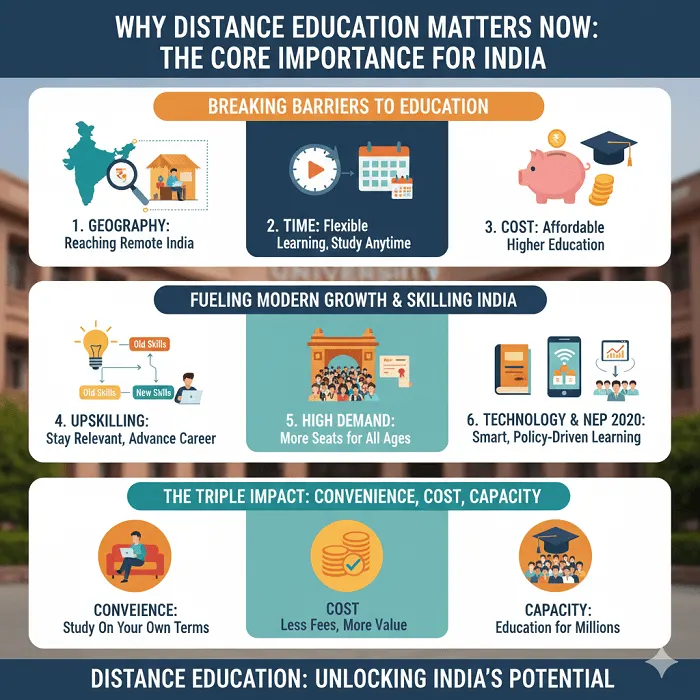
The most fundamental reason why distance learning is necessary today is Accessibility. Traditional education, which happens in a fixed building, creates many walls that stop people from learning. Distance education simply breaks these walls down.
1. Breaking the Wall of Geography (Location)
India is a huge country. Millions of people live in remote areas (villages, small towns, mountainous regions) where there are no good colleges or universities nearby.
- The Problem: Moving to a city for studies is expensive and difficult, especially for women and those with limited resources.
- The Solution (ODL’s Role): Distance education brings the university to the student’s home. A student in a remote village can study for a degree from a top metro city university without ever leaving their hometown. This ensures that where you live does not decide whether you get an education or not. It makes higher education for rural students a reality.
2. Breaking the Wall of Time (Flexibility)
Life does not pause for education. Many people cannot attend morning college classes because they are already busy earning a living, managing a home, or taking care of family members.
- The Problem: Traditional classes have a fixed schedule that clashes with work or home duties.
- The Solution (ODL’s Role): Distance education offers flexibility. Students can download lectures, read study material, and submit assignments at night, on weekends, or whenever they have free time. This flexibility is a game-changer, especially for working professionals and homemakers, allowing them to study without sacrificing their income or responsibilities.
3. Breaking the Wall of Cost (Affordability)
Getting a degree from a city college often costs a huge amount of money—fees, hostel rent, travel, and daily expenses.
- The Problem: High costs prevent many talented but poor students from continuing their education.
- The Solution (ODL’s Role): Distance education is significantly more cost-effective. By removing the need for daily travel, hostel fees, and other campus expenses, the overall cost of a degree comes down sharply. This makes it possible for students from economically weaker sections of society to get certified education, fulfilling the goal of making cost-effective higher education possible.
Meeting the Demands of a Modern Workforce
The current Indian society needs a workforce that is not only educated but also continuously upgrading its skills. This is why the Role of Open and Distance Learning (ODL) in Indian society is so critical today.
1. Catering to the Need for Upskilling
In today’s job market, the knowledge you gain today might become old tomorrow. People must constantly upskill (learn new, advanced skills) or reskill (learn skills for a completely new job) to stay competitive.
- The Problem: Taking a break from a job to attend a full-time course is not possible for most adults.
- The Solution (ODL’s Role): Distance education allows upskilling without leaving the job. A marketing manager can take an evening course on digital marketing, or an engineer can learn data science, all while continuing to draw their monthly salary. This rapid, continuous learning drives national productivity and helps individuals achieve career change.
2. Addressing the High Demand for Higher Education
India has one of the largest young populations in the world. The desire for a degree or a specialized certification is massive.
- The Problem: The number of quality physical university seats (capacity) is limited and cannot meet the demand of millions of students every year.
- The Solution (ODL’s Role): Distance education provides the necessary scale. It allows one university to teach thousands of students across different states at the same time without needing to build new physical infrastructure. This scalability is vital for increasing the country’s Gross Enrolment Ratio (GER) in higher education.
3. Support for Lifelong Learning
The traditional view was that education ends at age 22. The modern view, which ODL supports, is lifelong learning.
- The Problem: Older adults, retired people, or those who missed their chance at higher education earlier in life had no avenues to study.
- The Solution (ODL’s Role): Distance education provides a second chance. It allows anyone, regardless of age, to learn at their own pace. An 80-year-old can take a history course, and a 40-year-old homemaker can pursue her dream of getting a master’s degree. This inclusive approach enriches society and supports personal development throughout life.
The Strategic Importance for India’s Growth
When discussing the Significance of Distance Education in 21st Century India, we must look at its impact on the nation as a whole, not just on individuals.
1. Achieving Educational Equality
Distance education is a powerful force for social justice. It helps bridge the gap between the rich and the poor, and between those in cities and those in villages. By providing equal access to the same study materials, same degrees, and sometimes even the same faculty as regular colleges, ODL promotes equality of opportunity. This makes the entire society fairer and reduces regional disparities.
2. Supporting National Education Policy (NEP 2020)
The Government of India’s National Education Policy 2020 (NEP 2020) strongly promotes flexible learning pathways, the use of technology, and the removal of hard boundaries between different subjects.
- The Connection: Distance education fits this vision very well. It is naturally flexible and uses technology (like the SWAYAM platform). It lets students choose courses from different subjects—for example, a B.A. student can also study computer science. Because it breaks the rigid boundaries between subjects, ODL becomes an important tool for achieving the goals of the NEP.
3. Leveraging Technology
Distance learning has grown because more people now have internet access and smartphones. (Digital learning initiatives).
- The Advantage: ODL leverages technology to deliver high-quality, interactive content. Virtual classrooms, online assignments, recorded video lectures, and digital libraries make the learning experience rich and engaging. This modern approach ensures that Indian students are not just studying but are also becoming comfortable and skilled with the digital tools that define the modern workplace.
4. Addressing Teacher Shortages
In many specialized fields, India suffers from a shortage of high-quality teachers.
- The Problem: A limited number of subject experts cannot physically teach in every city.
- The Solution (ODL’s Role): Through distance learning, one expert can deliver a high-quality lecture to thousands of students across the entire country simultaneously. This efficient use of the limited pool of excellent teachers ensures that quality education is distributed widely, not just concentrated in a few city centers.
The Outlook: The Future of Distance Education in India
The Future of Distance Education in India is incredibly bright. It is evolving from a system used by a few people who couldn’t attend regular college, to a mainstream, preferred method of study for many.
As technology improves (faster internet, better learning apps, Artificial Intelligence in education), the quality and experience of distance learning will only get better. It is already leading to a blurring of the lines between “regular” and “distance” education, where many traditional universities now offer hybrid (part-online, part-classroom) models.
In conclusion, distance education is important for the present society because it delivers the three Cs that India needs for success:
- Convenience: It adapts to the student’s busy life.
- Cost-effectiveness: It makes education affordable for everyone.
- Capacity: It allows millions of people to get educated, regardless of where they live or what they do.
Distance education is a powerful driver of social mobility, economic growth, and national skill development. It helps ensure that no deserving learner is left behind in the search for knowledge. It is truly a key tool for unlocking the potential of a vast and diverse country like India in the 21st century.
❓ FAQs
1. What is the main difference between Distance Education and a Regular College?
The main difference is where and when the learning happens. In a regular college, you must attend classes in a fixed building at fixed times every day. In Distance Education (ODL), the student and teacher are separated. You learn using online materials, recorded videos, or printed books from your home, and you can study at any time that suits your schedule. This flexibility is the most significant benefit, making education possible for people who can’t leave their jobs or homes.
2. Why is Distance Education called a “necessity” for India today?
Distance education is a necessity because it helps solve India’s massive education demand and inequality problems. Our country has a huge population, and traditional colleges don’t have enough seats for everyone. More importantly, it brings education to people in remote areas and to those who are poor, elderly, or working. By making learning accessible and affordable to millions who would otherwise be left out, ODL directly helps in building a more skilled and equal society across the nation.
3. How does distance learning help people who already have a full-time job?
Distance learning is perfect for working professionals because it allows them to up skill or get a higher degree without having to quit their current job. They can study during their non-working hours, such as late evenings or weekends. This means they continue earning an income while simultaneously improving their qualifications. This ability to continuously learn is vital in today’s fast-changing job market, helping them stay competitive and secure promotions or better jobs.
4. How does Distance Education help people in remote villages get a good degree?
Distance Education breaks the wall of geography. A student in a remote village might not have a quality university nearby. To get a degree, they would traditionally have to move to a big city, which is very expensive. ODL allows them to enroll in a reputable university located far away and receive all the study materials and lectures right in their village, often using a computer or a smartphone. This gives them the same educational opportunity as city students without the high cost of moving.
5. Is a degree from a Distance Education program considered valuable in the job market?
Yes, a degree from a recognized Distance Education program is now widely valued, especially if the university is approved by the UGC (University Grants Commission). The quality of the degree depends on the institution, just like regular education. Many employers in India recognize that people who complete ODL programs are highly disciplined, motivated, and capable of managing their time well, as they studied while handling other responsibilities. The degree provides the necessary certification for career growth.
6. What do we mean by “lifelong learning,” and how does ODL support it?
Lifelong learning means that learning is not just something you do in your youth, but a continuous activity throughout your entire life, from childhood to old age. ODL strongly supports this because it is flexible and open to all ages. Someone who is 45 and wants to learn a new language, or a 60-year-old who wants to finally get the degree they missed, can easily enroll. It encourages everyone to update their skills and keep their minds active, which is essential in a fast growing world.
7. How does distance education help make higher education more affordable?
Distance education drastically reduces the costs associated with attending a physical college. Students do not have to pay for expensive things like hostel accommodation, daily travel, or campus maintenance fees. They only pay the tuition fee and the cost of study materials, which are often lower than regular courses. This focus on only the core academic cost makes ODL a cost-effective path, allowing many more students from economically weaker sections to afford a university degree.
8. How is the National Education Policy (NEP 2020) connected to Distance Education?
The NEP 2020 strongly pushes for flexibility and accessibility in the Indian education system. Distance Education is a perfect tool to achieve the NEP’s goals because it inherently offers flexible timings, allows students to choose subjects from different streams, and uses technology to deliver lessons. The NEP encourages more universities to offer quality online and distance programs to ensure that education is available to everyone, everywhere, which is the core strength of ODL.
9. Can Distance Education help bridge the gap between rich and poor students?
Yes, Distance Education acts as a great equalizer. It focuses on the quality of the learning material rather than the student’s ability to pay for a fancy college campus. Since the fees are lower and there are no travel costs, it removes the financial barrier that often stops poor students from accessing top education. By offering the same recognized degree to both the rich and the poor, ODL promotes educational equality and helps talented students from all economic backgrounds succeed.
10. Does distance education mainly rely on the internet and computers?
While the internet and computers are now the main tools for modern distance education (often called online learning), the system doesn’t only rely on them. ODL uses many methods, including printed study materials, television channels, and radio programs. However, the rise of smartphones and cheap data plans in India has made digital platforms very popular. This use of technology is key to its success, as it allows for interactive videos and quick access to information, supporting modern digital learning initiatives.